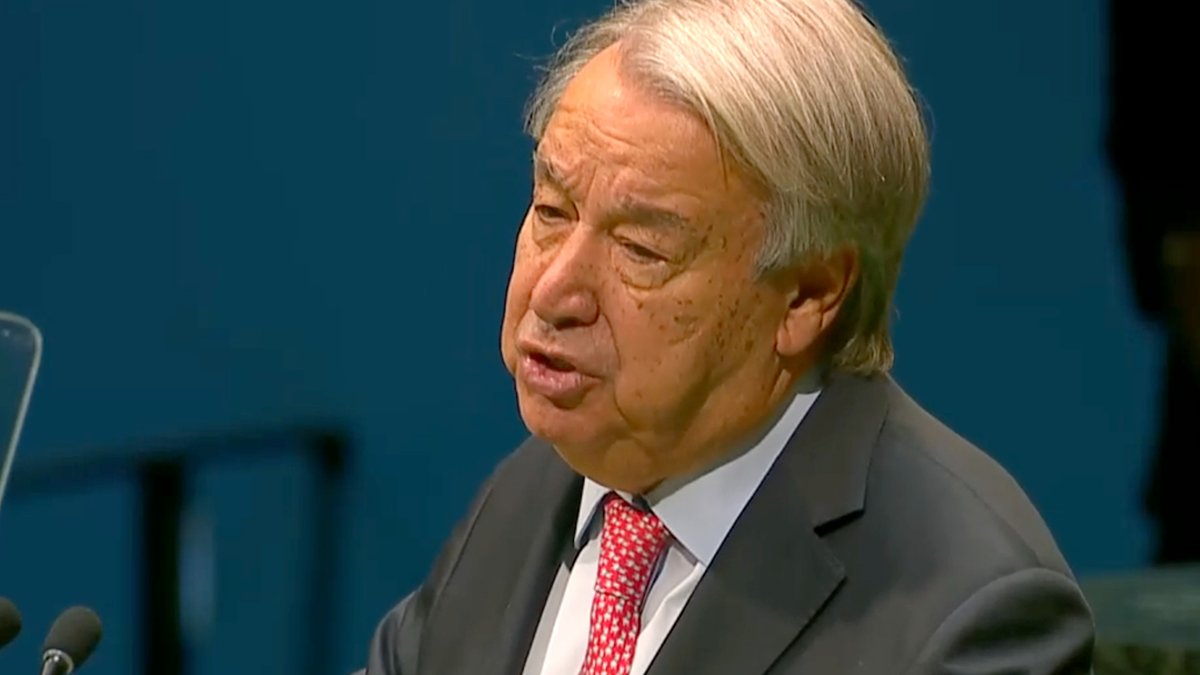
In his final address to the United Nations General Assembly as Secretary-General, António Guterres urged global cooperation to tackle war, inequality, the climate crisis, and the rapid rise of artificial intelligence. He stressed that humanity’s ability to wisely manage power will shape its shared future, emphasizing the need for collective action to address these interconnected challenges.
Guterres highlighted the need to uphold the law before impunity becomes normalized, end wars before they consume generations, tackle inequality before societies fracture, accelerate climate action before tipping points are crossed, and govern artificial intelligence before it governes humanity. He also stressed the importance of defending the rights of women and girls, who continue to face discrimination, violence, exclusion, and abuse around the world.
The UN chief noted that global institutions and systems of governance continue to reflect the power realities and interests of a largely bygone age. He called for a multilateral system centered in the UN that is balanced and representative, with strong, effective institutions that reflect the realities and the progressively changing relative weight of countries and economies in today’s world.
Guterres identified four great tests of power that will shape the future: the power over war and peace, the power that concentrates wealth and drives inequality, the power fueling climate chaos, and the power unleashed by artificial intelligence. He emphasized that these tests are linked and that the decisive issue is power – power over force, money, energy, technology, rules, and the future.
Climate Crisis Looms Large
The UN chief warned that the climate crisis is the most profound intergenerational power imbalance of all, with one generation consuming the future of the next. He called on every government to adopt a national plan to transition away from fossil fuels aligned with 1.5 degrees.
Guterres also highlighted the need for global coordination to address the challenges posed by artificial intelligence. He noted that AI has enormous promise to advance medicine, accelerate scientific discovery, expand opportunity, and improve lives, but it also poses significant risks if not governed responsibly.
Guterres emphasized that the four great tests of power are not separate crises, but rather chapters of the same story – the story of power. He called on nations to work together to address these tests and to ensure that power is governed by law, not by force or coercion.
The world is at a critical juncture, with the future of humanity hanging in the balance. The United Nations exists because power requires rules, and humanity needs a place where power answers to principle. Guterres called on nations to defend the values and principles of the UN Charter and to work towards a more peaceful, equitable, and sustainable world.
UN Chief Reflects on Legacy
As Guterres prepares to leave office, he emphasized that his commitment to the values and principles of the United Nations will not end with his mandate. He vowed to continue championing the conviction that peace is possible, that human dignity is universal, and that the power of law must prevail over the law of power.
Guterres’ presentation was part of the 81st session of the United Nations General Assembly, which is taking place amidst a backdrop of growing global challenges. The assembly will continue to discuss and address these challenges in the coming days, with a focus on finding solutions and promoting cooperation among nations.
Guterres’ presentation also highlighted the need for a new era of global governance, one that is more effective, more efficient, and more responsive to the needs of all nations and peoples. He called on nations to work together to reform the global governance system, including the United Nations, to make it more representative, more accountable, and more effective in addressing the challenges of the 21st century.